


182,297
likes
4,979
comments
daily view 0
monthly view 0
Live Analytics
Comments 0
Could This Change Air Travel Forever? Analytics Table
Income Estimates for Could This Change Air Travel Forever?
Based on this YouTube video's total view count of 12.9M views and industry-standard rates, the estimated total earning is $9.08K - $25.9K through ad revenue. Historical data is not yet available to calculate daily, weekly, or monthly averages.
About Could This Change Air Travel Forever?
Explore Could This Change Air Travel Forever? with 12,981,472 views, 182,297 likes, and 4,979 comments. Experience the impact of this video content that has captured audience attention.
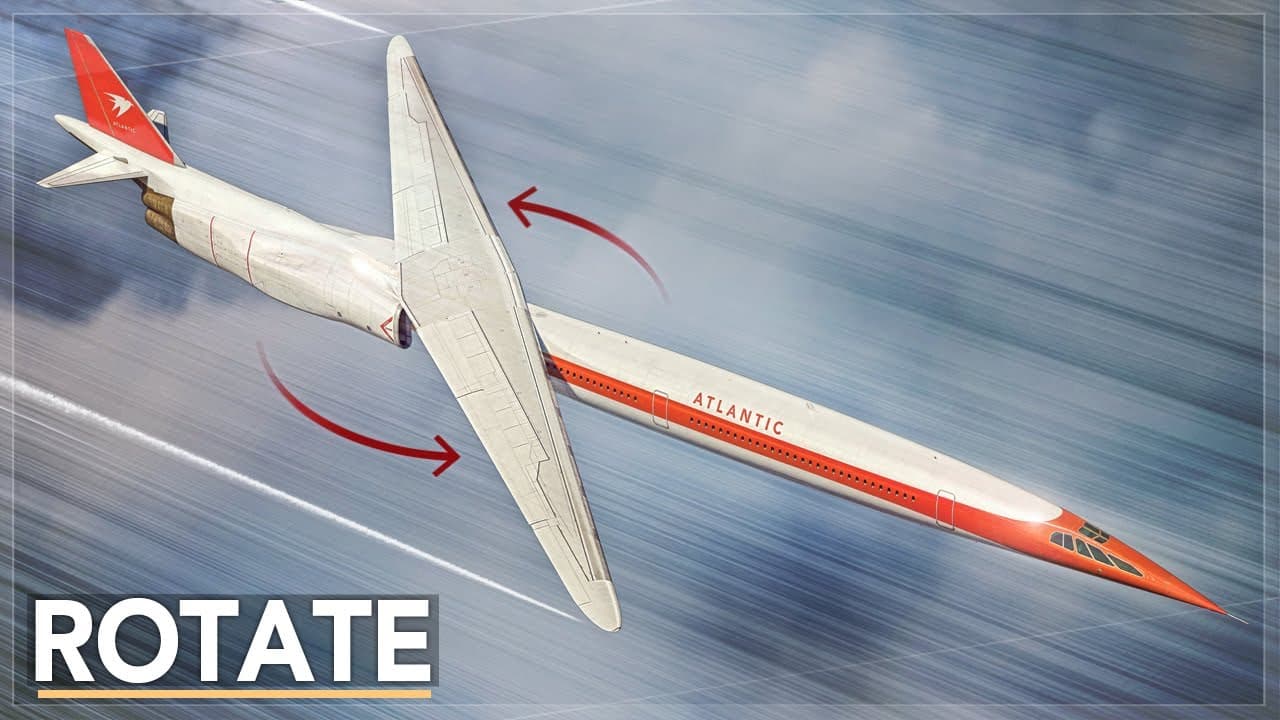
Get Nebula for just $2.50 a month here: https://go.nebula.tv/mustard Watch 'The Largest Aircraft Never Built - The Lockheed CL-1201' here: https://nebula.tv/videos/mustard-the-largest-aircraft-never-built-the-lockheed-cl1201 Patreon: https://www.patreon.com/MustardChannel Mustard Store: https://mustardchannel.com/ Instagram: https://www.instagram.com/mustard_channel Twitter: https://twitter.com/MustardVideos Facebook: https://www.facebook.com/Mustard-109952378202335 Bilateral symmetry is an unspoken assumption in aircraft design. Anything in nature that flies, from the smallest insect to the largest bird, possesses symmetry. But birds don't fly supersonic. In the 1950’s Robert Thomas Jones, a brilliant NASA engineer, began developing a radical new wing arrangement called an oblique wing (also referred to as a skewed wing). The wing design was characterized by a wing that could pivot into a unique angled configuration in relation to the aircraft’s fuselage. The design offered several advantages over more conventional swept wings. An oblique wing’s ability to pivot into a straight wing made it ideal for low speed flight (improving efficiency and take-off/landing performance), but at transonic and supersonic speeds, the angled orientation minimized both wave and induced drag, leading to improved overall aerodynamic efficiency. With lower drag at higher speeds, oblique wing aircraft would require less thrust to maintain a given speed, resulting in reduced fuel consumption and operating costs. Compared to other variable geometry wings, oblique wings would also be lighter, less complex and have fewer drawbacks like a shifting center of lift. Jones proved his theories through wind tunnel tests and with small scale remote control models. Promising results prompted NASA to undertake more intensive research during the 1970s. The first major step was the propeller-driven Oblique Wing Remotely Piloted Research Aircraft (OWRPRA) which first took flight in 1976. At the same time, aviation leaders Boeing and Lockheed were invited to study oblique wings to assess their benefits to commercial air travel. In 1979 the NASA Ames-Dryden-1 (AD-1), a subsonic, human piloted oblique wing aircraft began rigorous flight testing. NASA’s research efforts validated many of Jones’s theories, and the oblique wing demonstrated promise in real world flight. There were plans to follow the subsonic AD-1 program with a supersonic testing program using a modified U.S Navy F-8 fighter, but the program was cancelled early on in development. Budget constraints and shifting priorities have largely stalled intensive oblique wing research programs since the early 1990s. There are still widespread reservations about the flying qualities of highly asymmetrical aircraft. Flight control at extreme wing pivots is unfavorable and requires automated systems to augment flight control. Using modern flight control technologies and advanced materials, many of these drawbacks could be overcome. Oblique wings are still considered a viable concept for large transports and many are convinced that they will eventually be adopted. The advantages are simply too great to ignore. Key Research: “Thinking Obliquely: Robert T. Jones, the Oblique Wing, NASA’s AD-1 Demonstrator” by Bruce I. Larrimer (2019): https://www.nasa.gov/wp-content/uploads/2015/04/ThinkingObliquely-ebook.pdf
About YouTube Real-Time View Count
With SocialCounts.org’s view counter, track your YouTube video’s live view count and YouTube likes count in real time with fast, reliable updates.
Watch every YouTube video live view count rise with our real-time YouTube views tracker—built for accuracy and minimal delay.
Follow YouTube real time views as they happen, using our dedicated view counter for YouTube videos.
Get up-to-date live view count on YouTube and see real-time growth with SocialCounts.org’s smart tracking tools.
Embed Widget
Parameters:
fullscreen=true- Fullscreen countergraph=true- Live graph chartcounter=0/1/2- Select counter (0=likes, 1=views, 2=comments)
URL
Click to copy the embed URL to your clipboard