

26
likes
7
comments
daily view 0
monthly view 0
Live Analytics
Comments 0
A new kind of ion-drive, based on Tesla-coil radiation and high-frequency Lenz currents Analytics Table
Income Estimates for A new kind of ion-drive, based on Tesla-coil radiation and high-frequency Lenz currents
Based on this YouTube video's total view count of 1.12K views and industry-standard rates, the estimated total earning is $1 - $2 through ad revenue. Historical data is not yet available to calculate daily, weekly, or monthly averages.
About A new kind of ion-drive, based on Tesla-coil radiation and high-frequency Lenz currents
Explore A new kind of ion-drive, based on Tesla-coil radiation and high-frequency Lenz currents with 1,120 views, 26 likes, and 7 comments. Experience the impact of this video content that has captured audience attention.
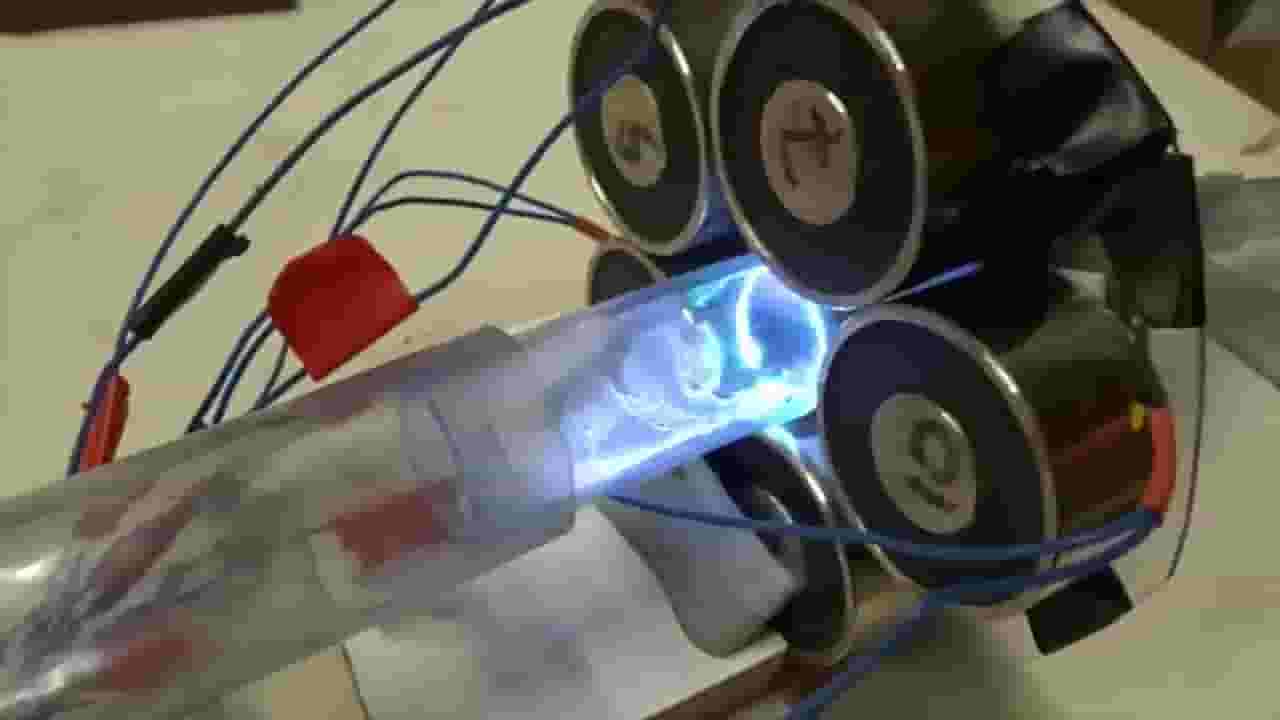
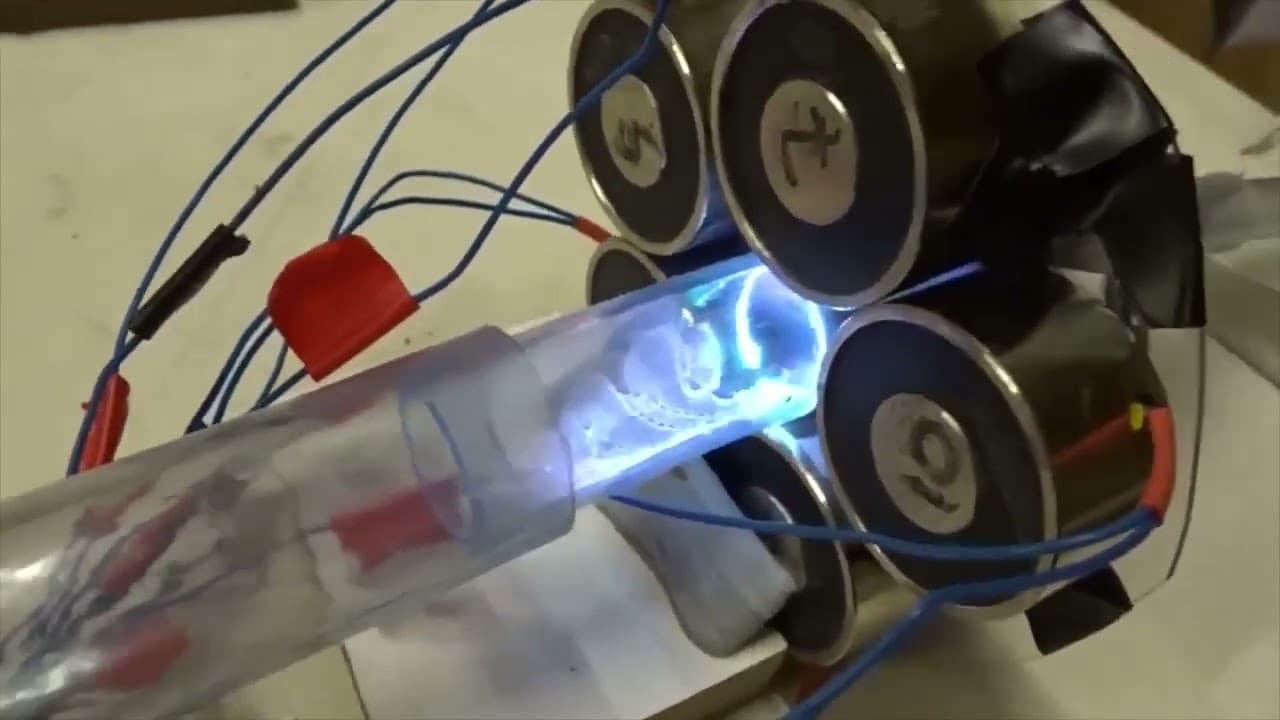
Notes Why do we use only chemical rockets? Why don’t we use ion-rockets? Natural fuels would be available all across our solar system. Perhaps our scientists have not found the most-suitable physics yet. What if we could use the high-frequency, magnetic Lenz repulsion of an ionized gas for “thrust”? We know about low-frequency, magnetic Lenz repulsions, but not yet about HIGH frequencies. In this video, we will first recall how high-voltage, high-frequency AC currents from a solid-state Tesla coil can IONIZE argon gas (see https://www.youtube.com/watch?v=aF4d6xNqP5A). Then we will show how to ACCELERATE argon cations and/or electrons, using induced Lenz currents from an aluminium disc and copper wire-coil, at very-high frequencies of 500 kHz. Lenz currents of low 50 Hz frequency do not seem to produce any useful effect. We added a copper wire-coil (800 turns of 0.5 mm PEI wire, resistance 20 ohms, inductance 75 milliHenries) around our plastic gas-supply tube, near the bare-end of its ionizing wire. A “flip switch” controls whether electrical currents will be induced in the wire coil. Next we placed an aluminium disc (3 mm thick), of the same diameter as the wire coil (100 mm), close up against it. Finally we connected that aluminium disc to the same Tesla-coil radiation, being used to ionize argon gas. We found it necessary to connect one (or both) of the leads from that wire coil to “ground”, through the “blue-neutral” wire of a 240-volt wall-outlet (switched off), to get strong, induced-Lenz currents at 500 kHz. The results were dramatic! As soon as we turned on the “flip switch”, ionized argon gas formed a “rocket-like exhaust”, in the direction of slow-flow by input argon gas. Both AC Lenz currents and magnetic fields were created strongly within the copper wire-coil, with opposite polarity and 90-degree delayed-phase, relative to Tesla-coil radiation in the ionizing wire. Thus in any AC cycle, immediately after certain atoms of argon gas get ionized by Tesla-coil radiation (due to its high-voltage electric, and high-frequency magnetic fields), those newly-formed ions seem to get exposed to strong Lenz-magnetic fields, which can repel them sideways as “thrust”. The effective lifetime of such newly-formed ions as “para-magnetic” may be VERY BRIEF. A repulsive Lenz force should be applied immediately, with opposite polarity and slightly-delayed phase from Tesla-coil radiation. Adding lots of AC wall-power at 50 Hertz seems to do NOTHING. After 1/50 of a second, the newly-formed gaseous ions have apparently lost their “magnetism”. Yet if we add carefully-timed pulses of Lenz energy at 500 kHz (once every 2 microseconds), then we seem to be able to repel newly-formed ions (or electrons) magnetically. If these new results can be extended from the current 50 watts, to higher kilowatt energies, then powerful ion-drives might be built to help us fly to Mars. Such new ion-drives would use high-frequency Lenz currents and magnetic fields as a means of propulsion. The solid-state Tesla coil used in these experiments is almost the same as described in a previous video (see https://www.youtube.com/watch?v=9bBmpW1Ka1c). Yet now we are using two NPN and PNP power-transistors, as the “driver” of 3-4 MOSFETS in parallel at just 5.0 volts DC. The NPN transistor has a 4.7k resistor on its collector input. Their joint-bases have a 2.2k resistor from the same DC power supply. We added a 1 nf polypropylene capacitor, along the resonance-feedback wire from that (bifilar-parallel) Tesla secondary-coil to the “driver”, to block any unwanted DC inputs. Just downstream from that 1 nf capacitor, we added a 12-volt Zener diode, to limit maximal power for the entire device, and so prevent the MOSFETs from over-heating. Previous videos in this series were: “How do the E.T. crop artists fly through space?” https://www.youtube.com/watch?v=klD8B4R_yo8 “A solid-state Tesla coil which makes large amounts of wireless energy: cheap and easy to build” https://www.youtube.com/watch?v=9bBmpW1Ka1c “Ionizing argon gas by three different, high-voltage methods” https://www.youtube.com/watch?v=aF4d6xNqP5A “Magneto-plasma dynamics using a Tesla coil, 40 kV DC and permanent magnets” https://www.youtube.com/watch?v=lL-tPw4ZwV0 “Magneto-plasma dynamics as drawn in crop pictures: 3 (+) wires wrapped around 1 (-)” https://youtu.be/Kuxbdt9Ng_8 “Simultaneous ionization and acceleration of argon gas by Tesla-coil wireless energies and high-frequency Lenz repulsions” https://youtu.be/8rp8RO592Yc Thanks to Kel and Angelo for help. Dr. Horace R. Drew owns full copyright of this video
About YouTube Real-Time View Count
With SocialCounts.org’s view counter, track your YouTube video’s live view count and YouTube likes count in real time with fast, reliable updates.
Watch every YouTube video live view count rise with our real-time YouTube views tracker—built for accuracy and minimal delay.
Follow YouTube real time views as they happen, using our dedicated view counter for YouTube videos.
Get up-to-date live view count on YouTube and see real-time growth with SocialCounts.org’s smart tracking tools.
Embed Widget
Parameters:
fullscreen=true- Fullscreen countergraph=true- Live graph chartcounter=0/1/2- Select counter (0=likes, 1=views, 2=comments)
URL
Click to copy the embed URL to your clipboard