

547
likes
70
comments
daily view 0
monthly view 0
Live Analytics
Comments 0
Why You Wouldn't Survive a Night on Medieval London's Streets in 1180 Analytics Table
Income Estimates for Why You Wouldn't Survive a Night on Medieval London's Streets in 1180
Based on this YouTube video's total view count of 32.1K views and industry-standard rates, the estimated total earning is $22 - $64 through ad revenue. Historical data is not yet available to calculate daily, weekly, or monthly averages.
About Why You Wouldn't Survive a Night on Medieval London's Streets in 1180
Explore Why You Wouldn't Survive a Night on Medieval London's Streets in 1180 with 32,107 views, 547 likes, and 70 comments. Experience the impact of this video content that has captured audience attention.
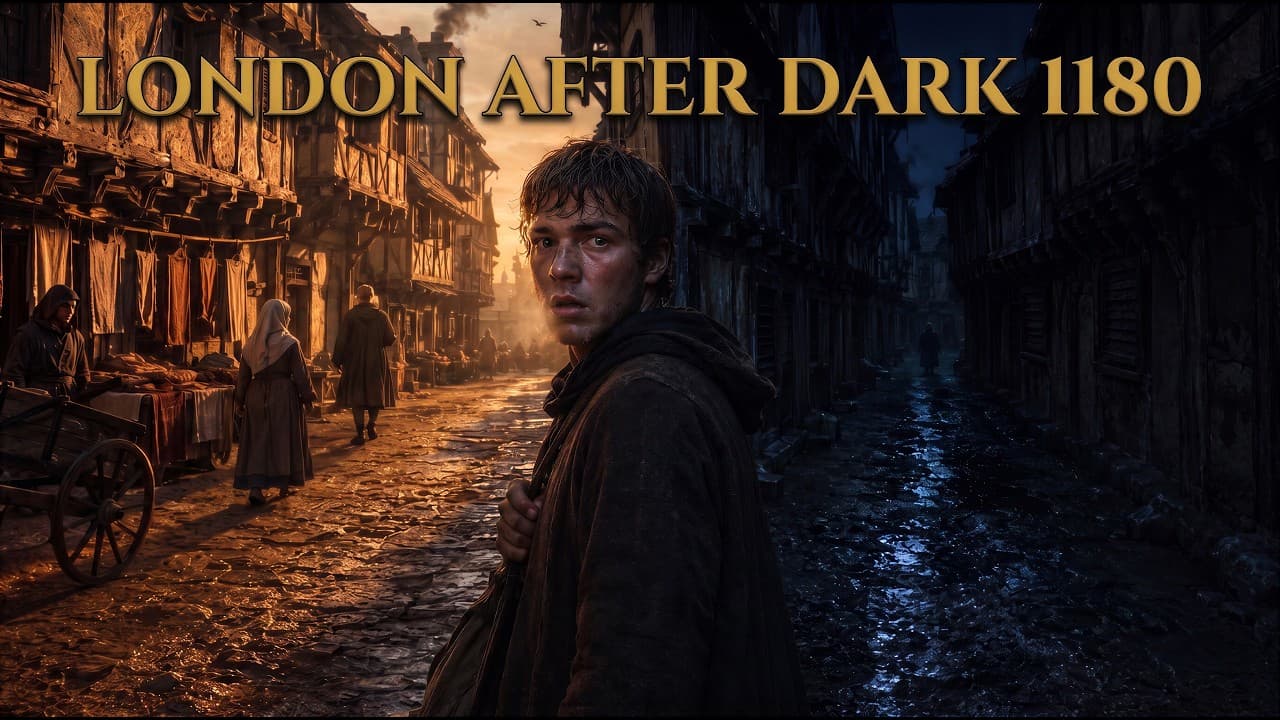
What was medieval London really like at night in 1180? By daylight, William FitzStephen called it the noblest city in the world — gardens behind every house, sweet springs, honest citizens. But FitzStephen went home before dark. At the stroke of the curfew bell, every gate locked, every fire was covered, and twenty-five thousand people vanished behind bolted doors — because the city they left outside had a murder rate fifteen to twenty times higher than today, and most of those killings happened in the hours right after the bell. So what actually happened on medieval London's streets after dark — and could you have survived a single night out there? In this AI historical reconstruction, we rebuild one night outside in the London of 1180 — the six-foot lanes where jettied houses nearly touch overhead, the filth and the Walbrook stream carrying the city's waste past the wells it drank from, the knives named in the coroners' rolls, the curfew law that turned anyone outdoors into a criminal, the Night Watch and the murdrum fine, the fire that a single spark could feed through a timber city — and the one light that saved more lives than any weapon. This is the real history of a medieval city at night — not the festival, not the fantasy. This is what the dark actually cost in the finest city in Christendom. If you enjoy historical reconstructions that show you how people actually lived in the past, subscribe to Worlds Before Us for more cinematic deep-dives into the forgotten realities of history. 🎬 HOW WE BUILT THIS VIDEO — AI HISTORICAL RECONSTRUCTION At Worlds Before Us, we use a combination of academic historical research and modern AI image and video generation tools to visually reconstruct lives that no camera was ever there to capture. Every frame in this video was generated from period-accurate references — William FitzStephen's 12th-century description of London, the London coroners' rolls, archaeological studies of medieval street levels and timber housing, and period manuscript illuminations — and then composed into cinematic sequences. The result lets you see, not just hear, what London's streets actually looked like after the curfew bell in 1180. We do not invent — we reconstruct, frame by frame, from the historical record. 📚 HISTORICAL SOURCES USED FOR THIS SCRIPT The script for this video draws on the following published works and primary sources for its claims about the curfew, night crime, the Watch, and the city's conditions: William FitzStephen — Descriptio Nobilissimae Civitatis Londoniae (c. 1173). The most detailed surviving 12th-century description of London, including the "two pests" passage quoted in this video. Christopher Brooke with Gillian Keir — London 800–1216: The Shaping of a City (Secker & Warburg, 1975). The standard history of London in exactly this era. Calendar of Coroners Rolls of the City of London, ed. R. R. Sharpe (1913). Primary records of the city's violent deaths, weapons, and juries. Barbara A. Hanawalt — Crime and Conflict in English Communities, 1300–1348 (Harvard University Press, 1979). Source for medieval urban murder rates, weapons, and the timing of violence after dark. Frank Rexroth — Deviance and Power in Late Medieval London (Cambridge University Press, 2007). Source for nightwalkers, curfew enforcement, and the policing of the night. Liber Albus: The White Book of the City of London, ed. H. T. Riley (1861). The city's own compiled regulations, including curfew and Watch ordinances. Museum of London — archaeological evidence of medieval street levels, housing, and recovered knives of the period. ⏱ TIMESTAMPS 00:00 FitzStephen's London — The Noblest City in Daylight 02:47 The Streets — Filth, the Walbrook, and Houses Three Feet Apart 06:30 Murder on Cheapside — Knives, Markets, and the Coroners' Rolls 08:53 The Curfew Bell and the Night Watch — London's Rules After Dark 12:21 Fire — The City That Kept Burning 14:29 Darkness — Why Night Multiplied Every Danger 17:28 The One Light That Saved Lives 🔔 SUBSCRIBE for more historical reconstructions #medievallondon #medievalhistory #middleages #historydocumentary
About YouTube Real-Time View Count
With SocialCounts.org’s view counter, track your YouTube video’s live view count and YouTube likes count in real time with fast, reliable updates.
Watch every YouTube video live view count rise with our real-time YouTube views tracker—built for accuracy and minimal delay.
Follow YouTube real time views as they happen, using our dedicated view counter for YouTube videos.
Get up-to-date live view count on YouTube and see real-time growth with SocialCounts.org’s smart tracking tools.
Embed Widget
Parameters:
fullscreen=true- Fullscreen countergraph=true- Live graph chartcounter=0/1/2- Select counter (0=likes, 1=views, 2=comments)
URL
Click to copy the embed URL to your clipboard