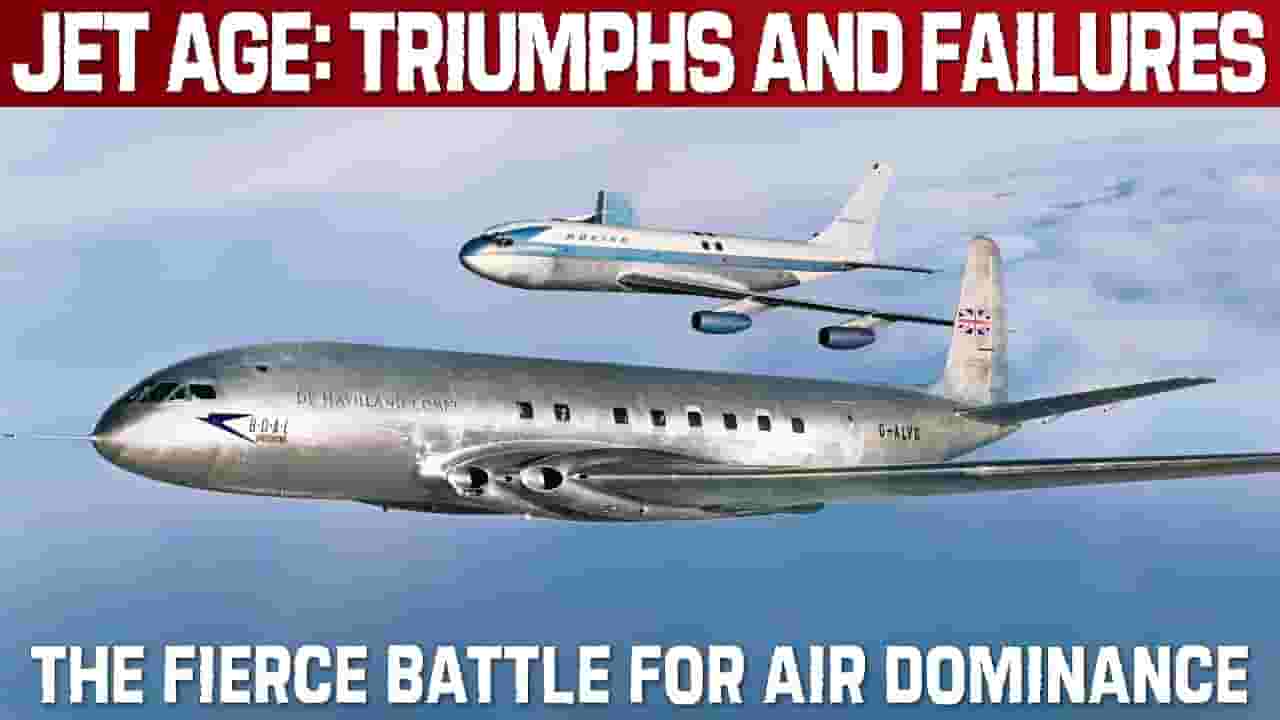



JET AGE: Triumphs And Failures. The Early Battle For Air Dominance: Boeing Vs. De Havilland
311,473
Socialcounts.Org
1,786
likes
124
comments
daily view 0
monthly view 0
Live Analytics
Comments 0
JET AGE: Triumphs And Failures. The Early Battle For Air Dominance: Boeing Vs. De Havilland Analytics Table
Income Estimates for JET AGE: Triumphs And Failures. The Early Battle For Air Dominance: Boeing Vs. De Havilland
Based on this YouTube video's total view count of 311K views and industry-standard rates, the estimated total earning is $218 - $623 through ad revenue. Historical data is not yet available to calculate daily, weekly, or monthly averages.
About JET AGE: Triumphs And Failures. The Early Battle For Air Dominance: Boeing Vs. De Havilland
Explore JET AGE: Triumphs And Failures. The Early Battle For Air Dominance: Boeing Vs. De Havilland with 311,473 views, 1,786 likes, and 124 comments. Experience the impact of this video content that has captured audience attention.
The early battle for air dominance after WW2. The Jet Age revolution of post WW2. De Havilland against Boeing, Tupolev, and many other aviation innovators. The De Havilland Comet became the first passenger jet airliner in the world, initially powered by Frank Whittle's turbojet, the British inventor who, contrary to popular belief, had a working turbojet before Germany in April 1937. Some initial mistakes are reminiscent of today's issues with companies like Boeing, who also had initial teething problems, just like De Havilland's notorious issue with their Comet. The de Havilland DH.106 Comet is the world's first commercial jet airliner. Developed and manufactured by de Havilland in the United Kingdom, the Comet 1 prototype first flew in 1949. It features an aerodynamically clean design, four de Havilland Ghost turbojet engines buried in the wing roots, a pressurized cabin, and large windows. It offered a relatively quiet, comfortable passenger cabin for the era and was commercially promising at its debut in 1952. Within a year of the airliner's entry into service, three Comets were lost in highly publicized accidents after suffering catastrophic mishaps mid-flight. Two of these were found to be caused by structural failure resulting from metal fatigue in the airframe, a phenomenon not fully understood at the time; the other was due to overstressing of the airframe during flight through severe weather. The Comet was withdrawn from service and extensively tested. Design and construction flaws were ultimately identified, including improper riveting and dangerous stress concentrations around square cut-outs for the ADF (automatic direction finder) antennas. As a result, the Comet was extensively redesigned with structural reinforcements and other changes. Rival manufacturers heeded the lessons from the Comet when developing their aircraft. Although sales never fully recovered, the improved Comet 2 and the prototype Comet 3 culminated in the redesigned Comet 4 series, which debuted in 1958 and remained in commercial service until 1981. The Comet was also adapted for various military roles such as VIP, medical, passenger transport, and surveillance; the last Comet 4, used as a research platform, made its final flight in 1997. The most extensive modification resulted in a specialized maritime patrol derivative, the Hawker Siddeley Nimrod, which remained in service with the Royal Air Force until 2011, over 60 years after the Comet's first flight. The Comet was involved in 25 hull-loss accidents, including 13 fatal crashes, which resulted in 492 fatalities.[186] Pilot error was blamed for the type's first fatal accident, which occurred during takeoff at Karachi, Pakistan, on 3 March 1953 and involved a Canadian Pacific Airlines Comet 1A.[82] Three fatal Comet 1 crashes were due to structural problems, specifically British Overseas Airways Corporation flight 783 on 2 May 1953, British Overseas Airways Corporation flight 781 on 10 January 1954, and South African Airways flight 201 on 8 April 1954, led to the grounding of the entire Comet fleet. After design modifications were implemented, Comet services resumed on October 4, 1958, with Comet 4s. Watch more aircraft, heroes, and their stories and missions ➤ https://www.youtube.com/@Dronescapes To support/join the channel ➤ https://www.youtube.com/@Dronescapes/join IG ➤ https://www.instagram.com/dronescapesvideos FB ➤ https://www.facebook.com/Dronescapesvideos X/Twitter ➤ https://dronescapes.video/2p89vedj THREADS ➤ https://www.threads.net/@dronescapesvideos #comet #Boeing #aviation
About YouTube Real-Time View Count
With SocialCounts.org’s view counter, track your YouTube video’s live view count and YouTube likes count in real time with fast, reliable updates.
Watch every YouTube video live view count rise with our real-time YouTube views tracker—built for accuracy and minimal delay.
Follow YouTube real time views as they happen, using our dedicated view counter for YouTube videos.
Get up-to-date live view count on YouTube and see real-time growth with SocialCounts.org’s smart tracking tools.
Embed Widget
Parameters:
fullscreen=true- Fullscreen countergraph=true- Live graph chartcounter=0/1/2- Select counter (0=likes, 1=views, 2=comments)
URL
Click to copy the embed URL to your clipboard