


24,228
likes
857
comments
daily view 0
monthly view 0
Live Analytics
Comments 0
The Biggest Black Holes in the Universe: Size Comparison (2026) Analytics Table
Income Estimates for The Biggest Black Holes in the Universe: Size Comparison (2026)
Based on this YouTube video's total view count of 541K views and industry-standard rates, the estimated total earning is $379 - $1.08K through ad revenue. Historical data is not yet available to calculate daily, weekly, or monthly averages.
About The Biggest Black Holes in the Universe: Size Comparison (2026)
Explore The Biggest Black Holes in the Universe: Size Comparison (2026) with 541,485 views, 24,228 likes, and 857 comments. Experience the impact of this video content that has captured audience attention.
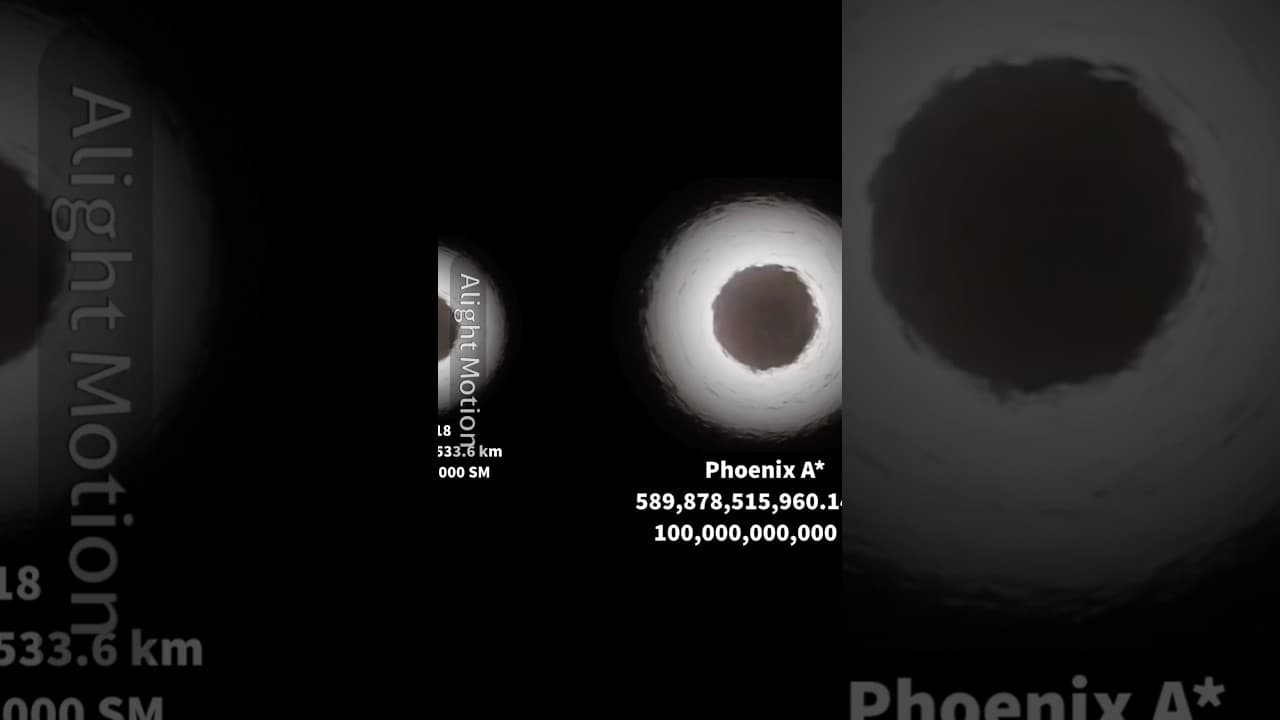
🌟 Size Comparison of Biggest black holes discovered by 2023 (+hypothetical ones) 🌐 A black hole is a region of spacetime where gravity is so strong that nothing, including light or other electromagnetic waves, has enough energy to escape it. The theory of general relativity predicts that a sufficiently compact mass can deform spacetime to form a black hole. The boundary of no escape is called the event horizon. Although it has a great effect on the fate and circumstances of an object crossing it, it has no locally detectable features according to general relativity. In many ways, a black hole acts like an ideal black body, as it reflects no light. Moreover, quantum field theory in curved spacetime predicts that event horizons emit Hawking radiation, with the same spectrum as a black body of a temperature inversely proportional to its mass. This temperature is of the order of billionths of a kelvin for stellar black holes, making it essentially impossible to observe directly. ❓ First some clarification: what is the "LAST Black Hole"? 📖 The Last Black Hole is the so-called very last black hole that will ever exist (provided that the decay of protons is possible, will occur after a certain time, and the effect of Hawking radiation does not dry out over time. If all conditions are met, the black hole epoch will last until about 10^110 years). According to the theory, this black hole will be formed by the merger of more than one hundred, if not thousands of black holes of various sizes and masses. According to the calculations (and based on the video melodysheep "TIMELAPSE OF THE FUTURE: A Journey to The End of Time", the black hole will reach a gigantic mass of 80-100 trillion suns, and possibly more (for comparison, the mass of our Milky Way galaxy is 1.5 trillion suns) 🤔 So, how did I calculate the estimated size of a black hole? ▪️ To begin with, let's exclude the concept of "theoretical limit", because we are talking about a very distant future (10^110 years). At this point, a typical black hole will be the size of Phoenix A* (due to black holes merging with each other) ▪️ A black hole, in fact, can grow indefinitely. For its growth, matter (stars, planets, galaxies, star dust) is needed, which the hole will suck in ▫️ We are looking for data on the mass of the Universe. It is equal to 7.5×10^53 kg (data from the Mitu Comparisons channel. Video "Mass Comparison 2020") ▫️ The mass of the Sun is 1.98847×10^30 kg ▫️ Calculate the mass of the Universe in solar masses: ▶ 7.5×10^53 kg / 1.98847×10^30 kg = 3.771744×10^23 SolarMass ▫️ The mass of matter in the universe is 31.5%. According to the law of conservation of mass, the mass of a physical system is conserved in all natural and artificial processes. In its metaphysical form, according to which matter is uncreated and indestructible, this law has been known since ancient times. And no one and nothing will add new mass to the Universe, except that the size of the Universe itself will increase. And so we get: ▶ 3.771744×10^23 SolarMass × 0.315 = 1.1880994×10^23 SolarMass ▫️ A black hole, of course, will not be able to suck in all the matter of the universe. Only some part of it. An insignificant part. In addition, matter (in its usual form) will exist until the decay of the last proton. Let's estimate: ▶ 1.1880994×10^23 SolarMass × 0.00001 = 1.1880994×10^18 SolarMass ▫️ Naturally, at the end of time there will not be only one black hole. Survive "units" against the general background. There may be several thousand left. Let's put the number at 15,000: ▶ 1.1880994×10^18 / 15,000 ≈ 80,000,000,000,000 SolarMass ⚠ Naturally, all calculations are very approximate. Maybe I didn't learn something. At the moment, only the mass of the Universe, the half-life of the proton, and the upper time limit of the era of black holes are known approximately. Based on the data that humanity has now, it is impossible to accurately determine the physical characteristics of the record-breaking black hole. But I think I got the point across. If you have something to add, advise, throw an idea or hypothesis, write in the comments! :) 🎶 Music in the video: Crystal Castles - Kerosene (Extra Slowed) _____________________________________________ Thank you for watching! If you enjoyed, make sure to subscribe, and thumb up. It will help us a lot! #yearofyou #astronomy #science #physics #simulation #astrophysics #education #edit #quantumphysics #blackhole #planets #spacelover #cosmology #future #nasa #space #multiverse #universe #earth #milkyway #sun #size #comparison #howto #youtube #facts #ai #shorts
About YouTube Real-Time View Count
With SocialCounts.org’s view counter, track your YouTube video’s live view count and YouTube likes count in real time with fast, reliable updates.
Watch every YouTube video live view count rise with our real-time YouTube views tracker—built for accuracy and minimal delay.
Follow YouTube real time views as they happen, using our dedicated view counter for YouTube videos.
Get up-to-date live view count on YouTube and see real-time growth with SocialCounts.org’s smart tracking tools.
Embed Widget
Parameters:
fullscreen=true- Fullscreen countergraph=true- Live graph chartcounter=0/1/2- Select counter (0=likes, 1=views, 2=comments)
URL
Click to copy the embed URL to your clipboard