

11,447
likes
596
comments
daily view 0
monthly view 0
Live Analytics
Comments 0
A Universal Theory of Brain Function Analytics Table
Income Estimates for A Universal Theory of Brain Function
Based on this YouTube video's total view count of 238K views and industry-standard rates, the estimated total earning is $167 - $478 through ad revenue. Historical data is not yet available to calculate daily, weekly, or monthly averages.
About A Universal Theory of Brain Function
Explore A Universal Theory of Brain Function with 238,845 views, 11,447 likes, and 596 comments. Experience the impact of this video content that has captured audience attention.
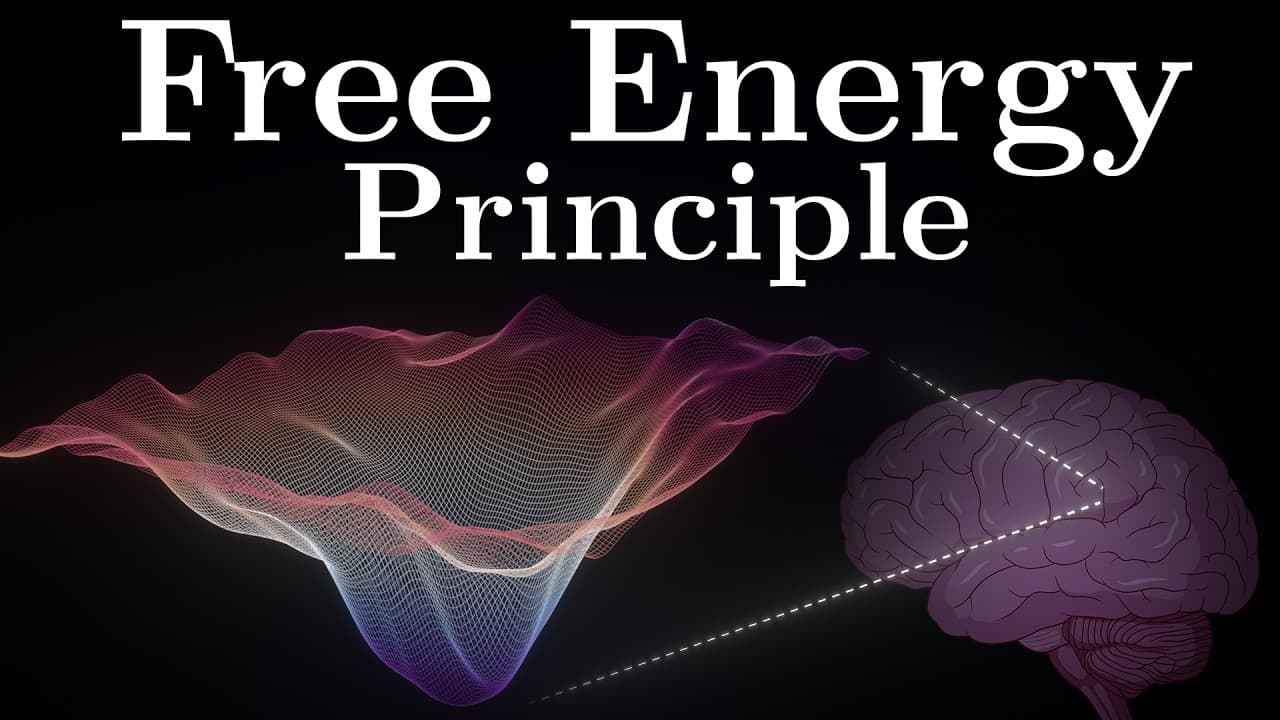
Head to https://squarespace.com/artem to save 10% off your first purchase of a website or domain using code ARTEM ===== My name is Artem, I'm a neuroscience PhD student at Harvard University. 🌎 Website and Social links: https://kirsanov.ai/ 📥 "Receptive Field" neuro-newsletter: https://artemkirsanov.substack.com/ ✨ Support me on Patreon to get access to Discord community: https://patreon.com/artemkirsanov ===== In this video explore Free Energy Principle – a powerful framework in neuroscience, which aims to explain brain function as predicting sensory observations through building models of the world. We discuss generative and recognition models, the role of priors, variational inference, and how free energy principle explains some every day observations such as optical illusion. This is a high-level conceptual, rather than mathematical treatment. 🕒 OUTLINE: 00:00 Introduction 01:34 Role of world models 03:56 Free Energy as tradeoff between accuracy and complexity 05:20 Sponsor: Squarespace 06:35 Generative Model 10:03 Priors 12:18 Approximate Inference via Recognition Model 14:14 Free Energy balance revisited 16:34 Explanation for optical illusion 17:55 Review 📚 FURTHER READING & REFERENCES: Bogacz, Rafal. “A Tutorial on the Free-Energy Framework for Modelling Perception and Learning.” Journal of Mathematical Psychology 76 (February 2017): 198–211. https://doi.org/10.1016/j.jmp.2015.11.003. Friston, Karl. “Learning and Inference in the Brain.” Neural Networks 16, no. 9 (November 2003): 1325–52. https://doi.org/10.1016/j.neunet.2003.06.005. Friston, Karl, Thomas FitzGerald, Francesco Rigoli, Philipp Schwartenbeck, John O’Doherty, and Giovanni Pezzulo. “Active Inference and Learning.” Neuroscience & Biobehavioral Reviews 68 (September 2016): 862–79. https://doi.org/10.1016/j.neubiorev.2016.06.022. Parr, Thomas, Giovanni Pezzulo, and K. J. Friston. Active Inference: The Free Energy Principle in Mind, Brain, and Behavior. Cambridge, Massachusetts: The MIT Press, 2022. ===== Icons by Freepik and Biorender ===== *Disclaimer:* This channel is my personal project. The views and content expressed here are my own and are separate from my research role at Harvard University. #Neuroscience #FreeEnergyPrinciple #BrainFunction _Description remastered: February 2026. Links & Bio updated; original context preserved._
About YouTube Real-Time View Count
With SocialCounts.org’s view counter, track your YouTube video’s live view count and YouTube likes count in real time with fast, reliable updates.
Watch every YouTube video live view count rise with our real-time YouTube views tracker—built for accuracy and minimal delay.
Follow YouTube real time views as they happen, using our dedicated view counter for YouTube videos.
Get up-to-date live view count on YouTube and see real-time growth with SocialCounts.org’s smart tracking tools.
Embed Widget
Parameters:
fullscreen=true- Fullscreen countergraph=true- Live graph chartcounter=0/1/2- Select counter (0=likes, 1=views, 2=comments)
URL
Click to copy the embed URL to your clipboard