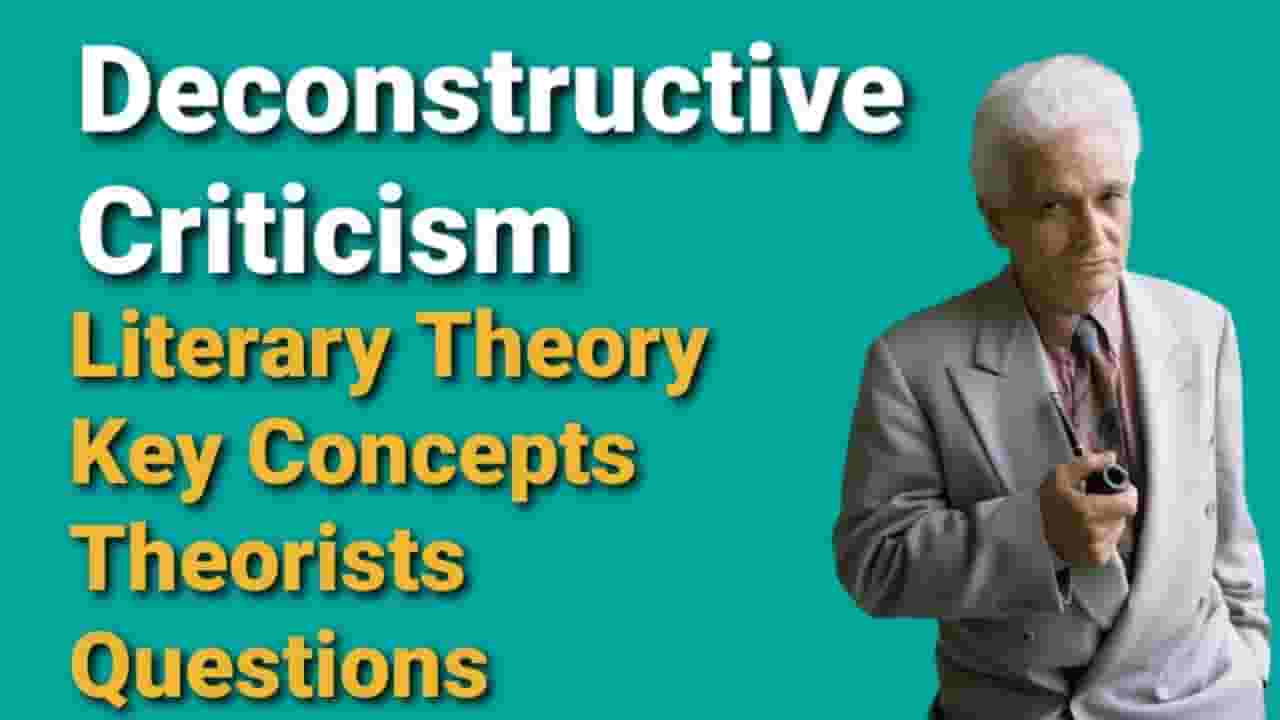
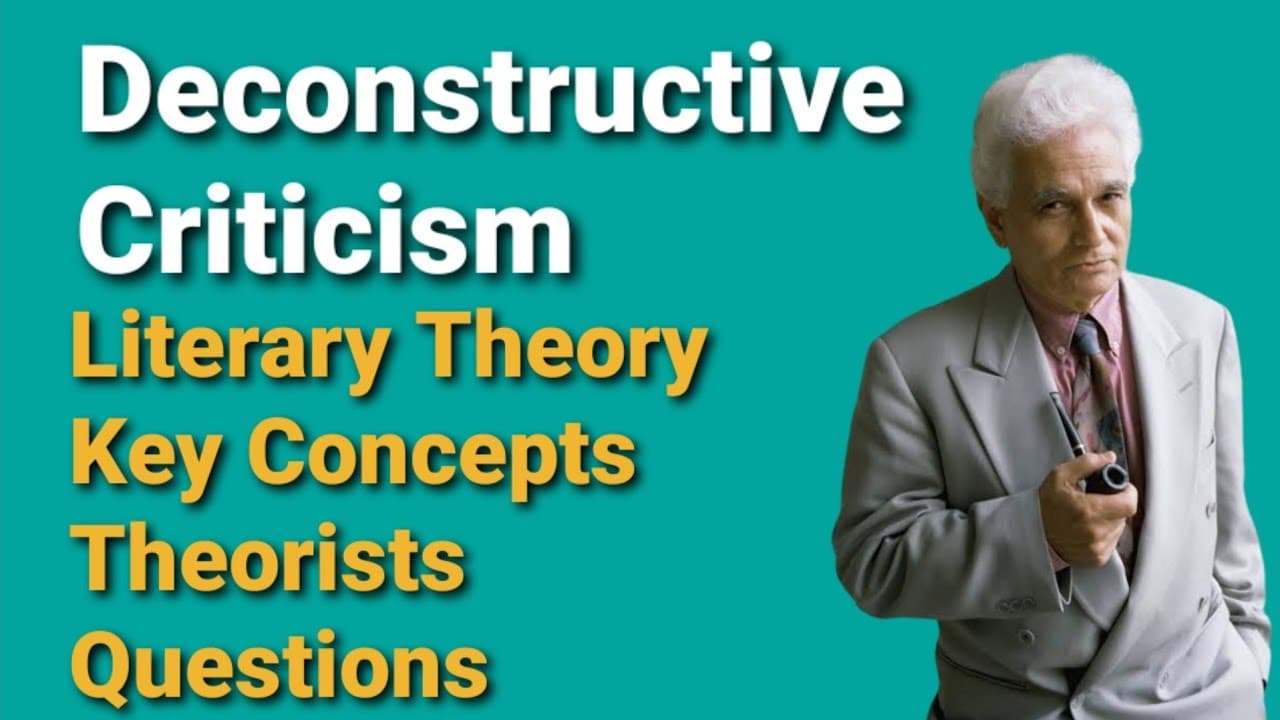


Deconstructive Criticism || Literary Theory || Concepts || Theorists || Questions
8,454
Socialcounts.Org
183
likes
10
comments
daily view 0
monthly view 0
Live Analytics
Comments 0
Deconstructive Criticism || Literary Theory || Concepts || Theorists || Questions Analytics Table
Income Estimates for Deconstructive Criticism || Literary Theory || Concepts || Theorists || Questions
Based on this YouTube video's total view count of 8.45K views and industry-standard rates, the estimated total earning is $6 - $17 through ad revenue. Historical data is not yet available to calculate daily, weekly, or monthly averages.
About Deconstructive Criticism || Literary Theory || Concepts || Theorists || Questions
Explore Deconstructive Criticism || Literary Theory || Concepts || Theorists || Questions with 8,454 views, 183 likes, and 10 comments. Experience the impact of this video content that has captured audience attention.
Deconstructive criticism is a literary theory that emerged in the late 1960s and early 1970s. It is an approach to literary analysis that aims to challenge the traditional understanding of language, meaning, and interpretation. Deconstructive criticism is based on the ideas of the French philosopher Jacques Derrida, who argued that language is inherently unstable and that meaning is always deferred or postponed. The goal of deconstructive criticism is to reveal the underlying assumptions and values that are embedded in a text. It seeks to expose the contradictions, paradoxes, and tensions within a text, and to challenge the dominant interpretations that have been imposed on it. Deconstructive criticism is not concerned with discovering the author's intention or the "correct" interpretation of a text, but rather with the process of interpretation itself. One of the key concepts in deconstructive criticism is "binary oppositions." According to this theory, language and meaning are constructed through a series of binary oppositions, such as good/evil, male/female, presence/absence, and so on. These oppositions are not fixed or stable, but are constantly in flux, and they are often based on hierarchies of power and privilege. Deconstructive criticism seeks to destabilize these binary oppositions by revealing the ways in which they are constructed and contested. It challenges the assumptions that underlie these oppositions, and exposes the ways in which they are used to marginalize or exclude certain groups of people. For example, the binary opposition of male/female is often used to reinforce patriarchal power structures, while the binary opposition of presence/absence can be used to exclude marginalized groups from the dominant discourse. Another important concept in deconstructive criticism is "différance." This term, which is unique to Derrida's theory, refers to the idea that meaning is always deferred or postponed. In other words, there is never a fixed or stable meaning to a text, but rather a series of provisional meanings that are constantly shifting and evolving. Différance challenges the idea that there is a single "correct" interpretation of a text, and instead emphasizes the importance of multiple readings and interpretations. Logocentrism: Logocentrism refers to the belief that there is a fixed and stable meaning to language. Deconstructive criticism challenges this belief by emphasizing the instability of language and meaning, and by showing how meaning is always deferred or postponed. Marginalization: Deconstructive criticism is concerned with the ways in which language and meaning are used to marginalize or exclude certain groups of people. It seeks to challenge the dominant power structures that reinforce these marginalizations. Subversion: Deconstructive criticism seeks to subvert traditional modes of interpretation by exposing the contradictions and tensions within a text, and by challenging the dominant interpretations that have been imposed on it. Reader Response: Deconstructive criticism emphasizes the role of the reader in constructing meaning from a text. It challenges the idea that there is a single "correct" interpretation of a text, and instead emphasizes the importance of multiple readings and interpretations. Irony: Irony is a key element of deconstructive criticism. It involves exposing the contradictions and tensions within a text, and using these to challenge the dominant interpretations that have been imposed on it. Here are some of the key theorists associated with deconstructive criticism: Jacques Derrida: Derrida is the founder of deconstructive criticism. His work emphasizes the instability of language and meaning, and challenges the idea that there is a fixed and stable meaning to a text. Paul de Man: De Man was a Belgian-born literary critic who became a leading proponent of deconstructive criticism in the United States. His work emphasizes the importance of irony and the ways in which language can be used to subvert dominant power structures. Gayatri Chakravorty Spivak: Spivak is an Indian scholar who has written extensively on deconstruction and postcolonialism. Her work emphasizes the importance of marginalization and the ways in which language can be used to exclude and silence certain groups of people. J. Hillis Miller: Miller is an American literary critic who has written extensively on deconstructive criticism. His work emphasizes the importance of reader response and the ways in which readers can construct meaning from a text. Barbara Johnson: Johnson was an American literary critic who specialized in deconstructive criticism. Her work emphasizes the importance of subversion and the ways in which language can be used to challenge dominant power structures. #deconstruction #derrida #literarytheory #literarycriticism #englishliterature
About YouTube Real-Time View Count
With SocialCounts.org’s view counter, track your YouTube video’s live view count and YouTube likes count in real time with fast, reliable updates.
Watch every YouTube video live view count rise with our real-time YouTube views tracker—built for accuracy and minimal delay.
Follow YouTube real time views as they happen, using our dedicated view counter for YouTube videos.
Get up-to-date live view count on YouTube and see real-time growth with SocialCounts.org’s smart tracking tools.
Embed Widget
Parameters:
fullscreen=true- Fullscreen countergraph=true- Live graph chartcounter=0/1/2- Select counter (0=likes, 1=views, 2=comments)
URL
Click to copy the embed URL to your clipboard