

1,837
likes
1
comments
daily view 0
monthly view 0
Live Analytics
Comments 0
Pre-Calculus Prep: VOLUME 6: Vectors Analytics Table
Income Estimates for Pre-Calculus Prep: VOLUME 6: Vectors
Based on this YouTube video's total view count of 3.10K views and industry-standard rates, the estimated total earning is $2 - $6 through ad revenue. Historical data is not yet available to calculate daily, weekly, or monthly averages.
About Pre-Calculus Prep: VOLUME 6: Vectors
Explore Pre-Calculus Prep: VOLUME 6: Vectors with 3,104 views, 1,837 likes, and 1 comments. Experience the impact of this video content that has captured audience attention.
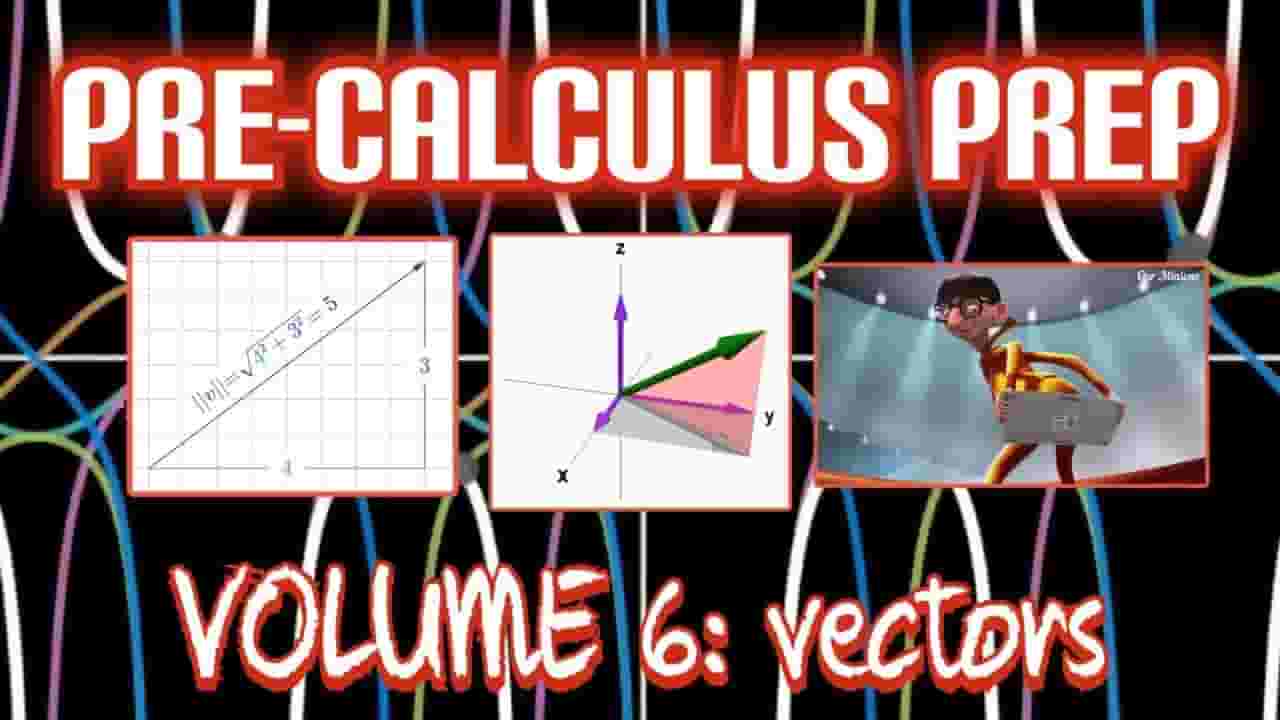
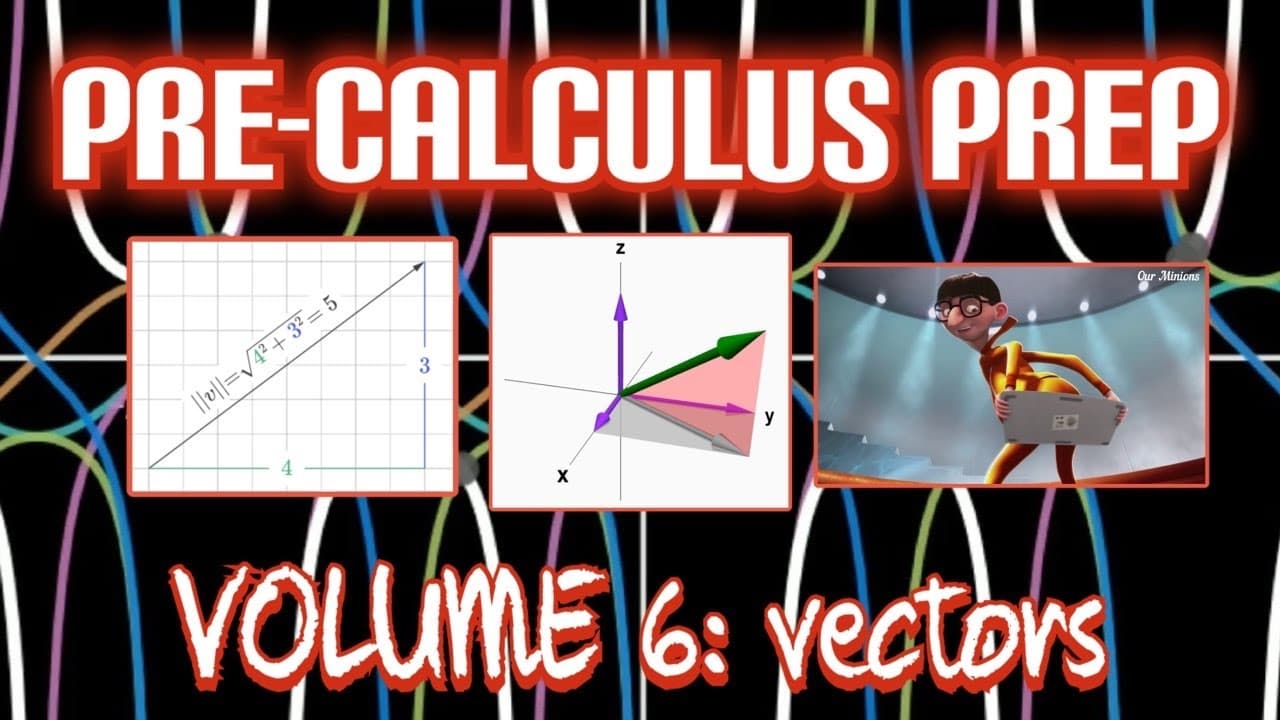
Please subscribe! https://www.youtube.com/channel/UCHKKyP6ezVQq5KunZVa-Mlg?sub_confirmation=1 Oh Yeah! This video is a compilation going over the following topics… 1. 2D Vectors: Vectors are mathematical objects that represent both magnitude (length) and direction. In two dimensions, vectors are typically represented as arrows with a starting point and an endpoint. They can be used to describe physical quantities like displacement, velocity, and force. 2. Component Form: The component form of a vector in 2D represents its x and y components. For example, a vector u can be written as u = (u₁, u₂), where u₁ represents the x-component and u₂ represents the y-component. 3. Unit Vectors: Unit vectors are vectors with a magnitude of 1. In 2D, the standard unit vectors are i and j, which point along the x-axis and y-axis, respectively. They are often used to express other vectors in terms of their components. 4. Magnitude: The magnitude of a vector represents its length or size. In 2D, the magnitude of a vector u = (u₁, u₂) is calculated using the Pythagorean theorem as |u| = √(u₁² + u₂²). 5. Direction Angle: The direction angle of a vector in 2D represents the angle it makes with the positive x-axis. It is typically measured in radians or degrees and can be determined using trigonometric functions such as arctan(u₂/u₁). 6. Resultant Vectors: Resultant vectors are obtained by performing operations on multiple vectors. - Scalar Multiplication: Scalar multiplication involves multiplying a vector by a scalar (real number), which affects only the magnitude and can change the direction if the scalar is negative. - Vector Addition: Vector addition combines two or more vectors by adding their corresponding components. The resulting vector is the sum of the individual vectors. - Vector Subtraction: Vector subtraction is similar to vector addition, but instead of adding corresponding components, we subtract them to obtain the difference between vectors. 7. Dot Product: The dot product (also known as the scalar product) is an operation that takes two vectors and produces a scalar. In 2D, the dot product of vectors u = (u₁, u₂) and v = (v₁, v₂) is calculated as u · v = u₁v₁ + u₂v₂. The dot product is useful for determining angles, projections, and finding orthogonal (perpendicular) vectors. 8. Projection of u onto v: The projection of vector u onto vector v is a vector that represents the component of u that lies in the same direction as v. It can be calculated using the formula projᵥu = (u · v) / |v| * v, where · represents the dot product. 9. Angles Between Vectors: The angle between two vectors u and v in 2D can be calculated using the dot product as cos(θ) = (u · v) / (|u| * |v|). The resulting angle can be used to determine if the vectors are parallel, perpendicular, or at an arbitrary angle to each other. 10. 3D Vectors: Vectors in three dimensions (3D) are similar to 2D vectors but have an additional component representing the z-direction. They can be represented as u = (u₁, u₂, u₃) and are used to describe three-dimensional quantities, such as position, displacement, and force. 11. Cross Products: The cross product (also known as the vector product) is an operation specific to three dimensions that takes two vectors and produces a third vector perpendicular to both. The cross product of vectors u = (u₁, u₂, u₃) and v = (v₁, v₂, v₃) is calculated as u × v = (u₂v₃ - u₃v₂, u₃v₁ - u₁v₃, u₁v₂ - u₂v₁). The cross product is useful for determining the area of parallelograms, finding normal vectors, and solving problems in physics and engineering. This video goes over how to solve an equation in logarithmic form by converting it into exponential form, and then solving an equation involving rational parts. These videos are designed to review and reteach Precalculus and Collegeboard Pre-CALC AP content. My videos cover functions, polynomials, exponential and logarithmic expressions, trigonometry, parametric equations, polar coordinates, vectors, matrices and systems, conic sections, discrete mathematics, sequences and series; and an introduction to calculus. I have many informative videos for Pre-Algebra, Algebra 1, Algebra 2, Geometry, Pre-Calculus, and Calculus. Please check it out: https://youtube.com/c/NickPerich Nick Perich Norristown Area High School Norristown Area School District Norristown, Pa . . . #math #maths #mathskills #mathsucks #mathstudent #mathsmemes #mathstudents #mathsteacher #mathsisfun #gcsemaths #quickmaths #mathstutor #mathsclass #mathstricks #mathsjokes #brunomathsson #mathstations #mathslover #mathsproblems #mathsfun #alevelmaths #earlymaths #mathsquiz #mathsmeme #mathsmock #mathsnotes #mathsbeauty #ilovemaths #lovemaths #addmaths #mathsforlife #mathsweek #mathsgames #mathsexam #eyfsmaths #mathsrevision #primarymaths #ihatemaths #mathslesson #mathstuition #math #shorts #funny #help #onlineclasses #onlinelearning #online #study
About YouTube Real-Time View Count
With SocialCounts.org’s view counter, track your YouTube video’s live view count and YouTube likes count in real time with fast, reliable updates.
Watch every YouTube video live view count rise with our real-time YouTube views tracker—built for accuracy and minimal delay.
Follow YouTube real time views as they happen, using our dedicated view counter for YouTube videos.
Get up-to-date live view count on YouTube and see real-time growth with SocialCounts.org’s smart tracking tools.
Embed Widget
Parameters:
fullscreen=true- Fullscreen countergraph=true- Live graph chartcounter=0/1/2- Select counter (0=likes, 1=views, 2=comments)
URL
Click to copy the embed URL to your clipboard