

3
likes
0
comments
daily view 0
monthly view 0
Live Analytics
Comments 0
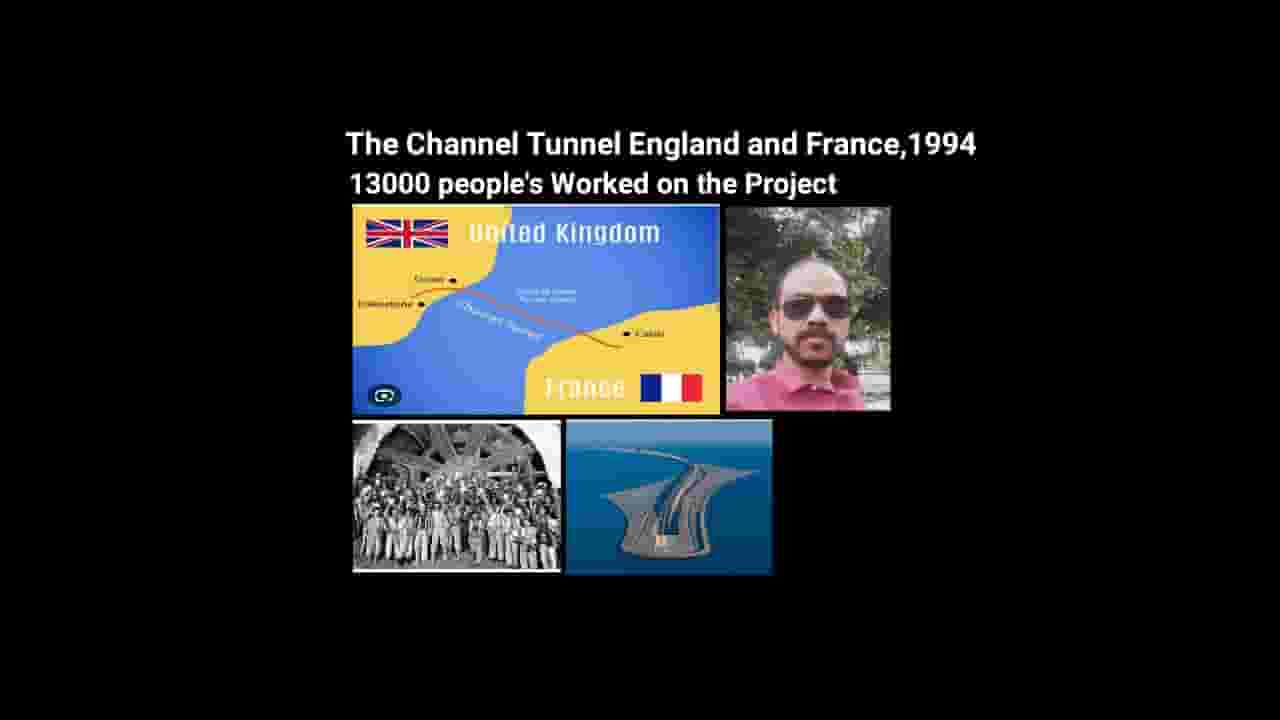
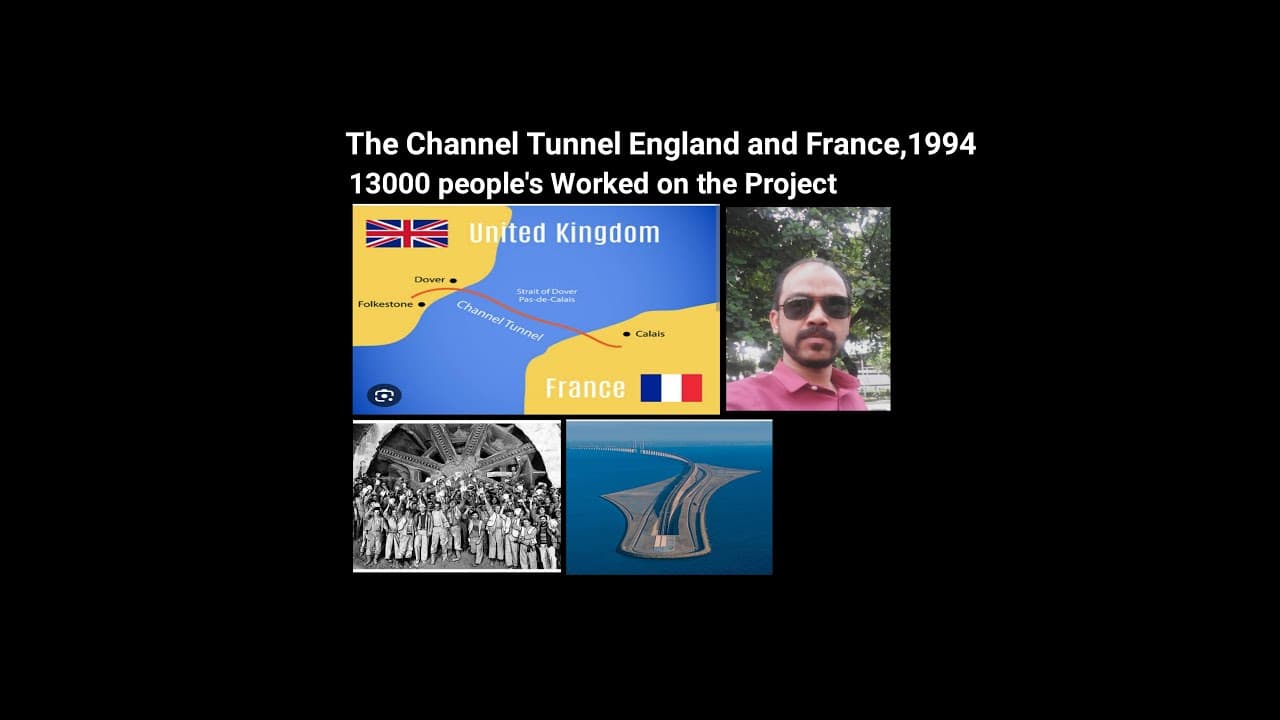
The Channel Tunnel England and France,1994 ,world longest underwater Tunnel (Part 1) Analytics Table
Income Estimates for The Channel Tunnel England and France,1994 ,world longest underwater Tunnel (Part 1)
Based on this YouTube video's total view count of 123 views and industry-standard rates, the estimated total earning is $0 - $0 through ad revenue. Historical data is not yet available to calculate daily, weekly, or monthly averages.
About The Channel Tunnel England and France,1994 ,world longest underwater Tunnel (Part 1)
Explore The Channel Tunnel England and France,1994 ,world longest underwater Tunnel (Part 1) with 123 views, 3 likes, and 0 comments. Experience the impact of this video content that has captured audience attention.
BEGINNINGS, 1802–1945 1. The early possibilities Interest in the idea of linking Britain to the continent of Europe and specifically to France is usually identified as beginning in the early nineteenth century. In the middle of the French Wars, a French mining engineer, Jacques-Joseph MathieuFavier, apparently made the somewhat implausible suggestion that the time was ripe to link countries who were then enemies. His proposal envisaged a twogallery tunnel from Cap Gris Nez to Folkestone, to be constructed from each side to an artificial island on Varne bank in mid-channel. Services were to be provided by horse-drawn coaches. It seems that during the brief peace of Amiens in 1802–3 Napoleon expressed an interest in the proposal, and in informal discussions with Charles James Fox, a former foreign secretary, it was suggested that the scheme was ambitious enough to require the two countries to undertake it jointly. However, the resumption of war for a further decade and a half put paid to such exploratory discussions.1 In the first half of the century the initiatives for a fixed link crossing came mainly from the French. Bridges, bored tunnels, and immersed tubes were all suggested. In the 1830s the mining engineer Thomé de Gamond began four decades of investigation of the Channel strata, making a significant contribution by asserting that the chalk strata were continuous.2 Another leading figure was Hector Horeau, who advanced the idea of a submerged tube in 1851. However, the British were never far behind, as the work of James Wylson, William Low and John Hawkshaw demonstrates (Table 1.1). In 1855 Wylson proposed an ingenious if somewhat implausible f loating tunnel, anchored by ties and buoys, costed at £15 million. More importantly, it was the work of the British engineers Low and Hawkshaw in the 1860s that had the most influence in engineering terms. Low teamed up with de Gamond and another British engineer, John Brunlees, to produce the first serious plan for a tunnel, between Dover’s South Foreland and Sangatte, near Calais.3 Hawkshaw’s privately funded trial borings in 1865–7 convinced de Gamond to abandon the idea of using Varne bank for a more direct route through the chalk between St. Margaret’s Bay, east of Dover, and Sangatte. De Gamond was also encouraged to join an Anglo-French consortium led by The Channel Tunnel is a 50.5 km-long rail tunnel beneath the English Channel at the Straits of Dover. It connects Dover, Kent in England with Calais, northern France. The undersea section of the tunnel is unsurpassed in length in the world. A proposal for a Channel tunnel was first put forward by a French engineer in 1802. In 1881, a first attempt was made at boring a tunnel from the English side; the work was halted after 800 m. Again in 1922, English workers started boring a tunnel, and advanced 120 m before it too was halted for political reasons. The most recent attempt was begun in 1987, and the tunnel was officially opened in 1994. At completion it was estimated that the project cost around $18 billion. It has been operating at a significant loss since its opening, despite trips by over 7 million passengers per year on the Eurostar train, and over 3 million vehicles per year. With its 14 spectral bands from the visible to the thermal infrared wavelength region, and its high spatial resolution of 15 to 90 meters (about 50 to 300 feet), ASTER images Earth to map and monitor the changing surface of our planet. ASTER is one of five Earth-observing instruments launched December 18, 1999, on NASA's Terra satellite. The instrument was built by Japan's Ministry of Economy, Trade and Industry. A joint U.S./Japan science team is responsible for validation and calibration of the instrument and the data products. The broad spectral coverage and high spectral resolution of ASTER provides scientists in numerous disciplines with critical information for surface mapping, and monitoring of dynamic conditions and temporal change. Example applications are: monitoring glacial advances and retreats; monitoring potentially active volcanoes; identifying crop stress; determining cloud morphology and physical properties; wetlands evaluation; thermal pollution monitoring; coral reef degradation; surface temperature mapping of soils and geology; and measuring surface heat balance. The U.S. science team is located at NASA's Jet Propulsion Laboratory, Pasadena, Calif. The Terra mission is part of NASA's Science Mission Directorate. Size: 59.4 by 63.1 kilometers (36.0 by 39.1 miles) Location: 51 degrees North latitude, 1.5 degrees East longitude Orientation: North at top Image Data: ASTER bands 3, 2, and 1 Original Data Resolution: 15 meters (49.2 feet)
About YouTube Real-Time View Count
With SocialCounts.org’s view counter, track your YouTube video’s live view count and YouTube likes count in real time with fast, reliable updates.
Watch every YouTube video live view count rise with our real-time YouTube views tracker—built for accuracy and minimal delay.
Follow YouTube real time views as they happen, using our dedicated view counter for YouTube videos.
Get up-to-date live view count on YouTube and see real-time growth with SocialCounts.org’s smart tracking tools.
Embed Widget
Parameters:
fullscreen=true- Fullscreen countergraph=true- Live graph chartcounter=0/1/2- Select counter (0=likes, 1=views, 2=comments)
URL
Click to copy the embed URL to your clipboard