

165
likes
27
comments
daily view 0
monthly view 0
Live Analytics
Comments 0
AP Precalculus Review on Sections 1.7, 1.8, 1.9 and 1.10 (Reteaching and Test Practice Problems) Analytics Table
Income Estimates for AP Precalculus Review on Sections 1.7, 1.8, 1.9 and 1.10 (Reteaching and Test Practice Problems)
Based on this YouTube video's total view count of 11.1K views and industry-standard rates, the estimated total earning is $8 - $22 through ad revenue. Historical data is not yet available to calculate daily, weekly, or monthly averages.
About AP Precalculus Review on Sections 1.7, 1.8, 1.9 and 1.10 (Reteaching and Test Practice Problems)
Explore AP Precalculus Review on Sections 1.7, 1.8, 1.9 and 1.10 (Reteaching and Test Practice Problems) with 11,140 views, 165 likes, and 27 comments. Experience the impact of this video content that has captured audience attention.
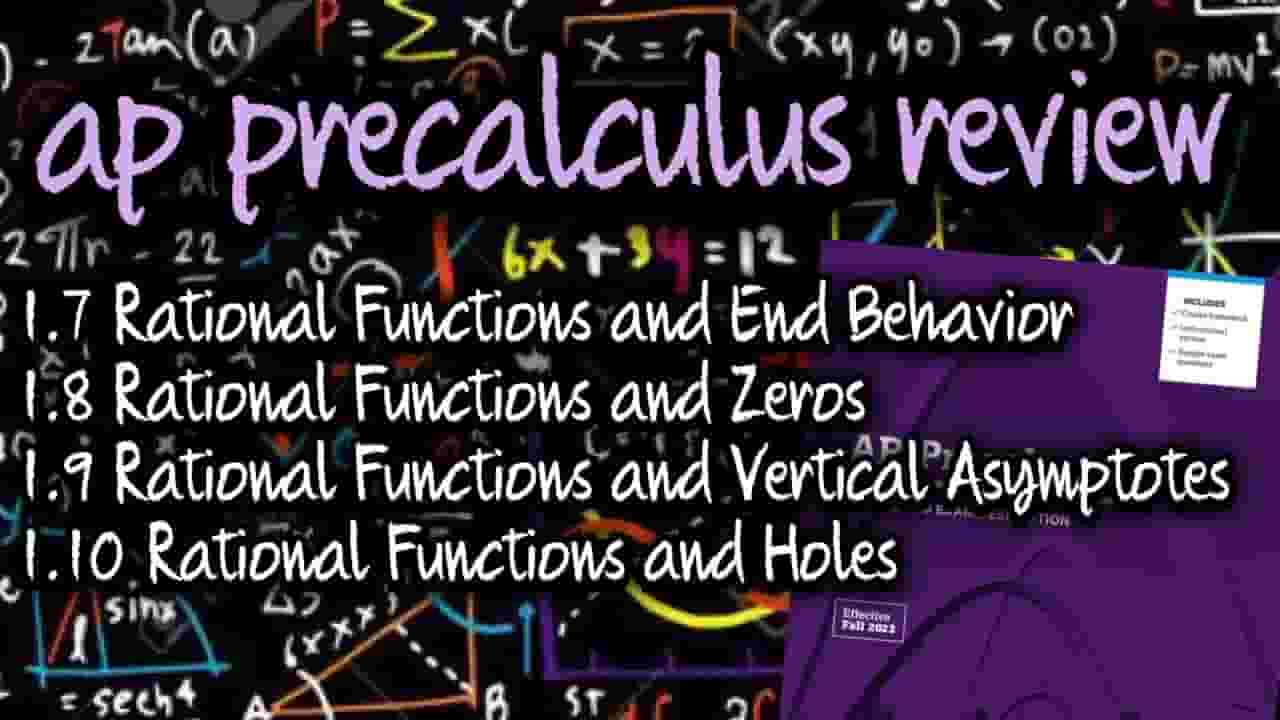
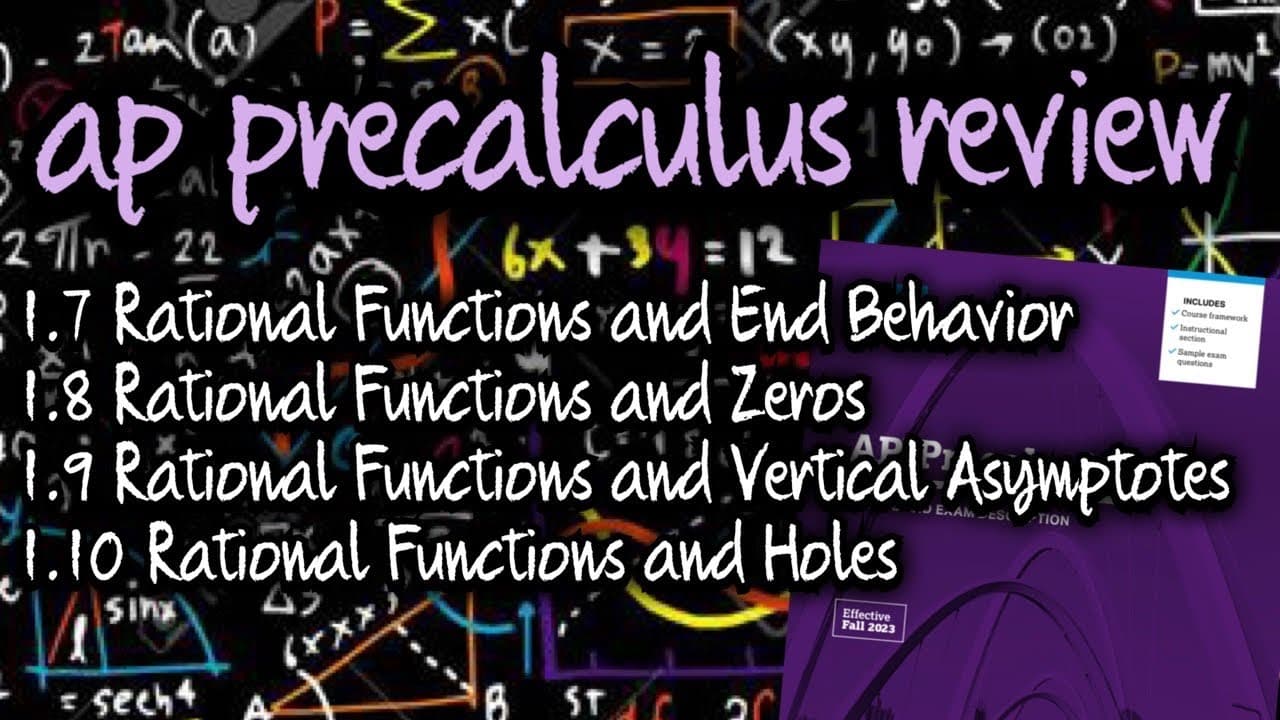
Please subscribe: https://www.youtube.com/channel/UCHKKyP6ezVQq5KunZVa-Mlg?sub_confirmation=1 Unit 1: Polynomial and Rational Functions 1.7 Rational Functions and End Behavior 1.8 Rational Functions and Zeros 1.9 Rational Functions and Vertical Asymptotes 1.10 Rational Functions and Holes In this video, I thoroughly describe and reteach the main components of the sections listed above found in the official College Board AP Precalculus course description found at https://apcentral.collegeboard.org/media/pdf/ap-precalculus-course-and-exam-description.pdf. Afterwords, I provide multiple examples and give descriptive solutions to AP Precalculus-style problems. Topics in this video include… Certainly, here's a brief description of these key concepts related to rational functions in an AP PreCalculus context: 1. Zeros (Roots): Zeros of a rational function are values of the variable (usually denoted as "x") for which the function equals zero. They are the solutions to the numerator of the rational function equaling zero. Zeros are also called roots. 2. Vertical Asymptotes: Vertical asymptotes are vertical lines that a rational function approaches as x gets closer to certain values. These values are typically the solutions to the denominator of the rational function equaling zero, and the function becomes undefined at these points. 3. End Behavior: End behavior describes how the rational function behaves as x approaches positive and negative infinity. It is often determined by comparing the degrees of the numerator and denominator polynomials. 4. Holes (Point Discontinuities): Holes in a rational function occur when factors in the numerator and denominator cancel each other out, causing a removable discontinuity at a specific x-value. They are represented as (x, y) points on the graph where the function is undefined but can be "filled in" with the appropriate value. 5. Multiplicity: Multiplicity refers to the number of times a specific factor (zero or root) appears in the numerator or denominator of a rational function. It affects how the graph interacts with the x-axis at that point. 6. Slant Asymptotes (Oblique Asymptotes): Slant asymptotes occur when the degree of the numerator is one greater than the degree of the denominator. In this case, the rational function has a diagonal asymptote rather than a horizontal or vertical one. 7. Limit Notation: In the context of rational functions, limit notation is used to describe the behavior of the function as x approaches a specific value (e.g., lim(x → c) f(x) represents the limit of the function f(x) as x approaches the value c). Understanding these concepts is essential for analyzing and graphing rational functions in AP PreCalculus, as they provide insights into the behavior of these functions and how they interact with the coordinate plane. These concepts are fundamental in precalculus and serve as building blocks for more advanced mathematical topics. I have many informative videos for Pre-Algebra, Algebra 1, Algebra 2, Geometry, Pre-Calculus, and Calculus. Please check it out: https://youtube.com/c/NickPerich Nick Perich Norristown Area High School Norristown Area School District Norristown, Pa . . #math #maths #mathskills #mathsucks #mathstudent #mathsmemes #mathstudents #mathsteacher #mathsisfun #gcsemaths #quickmaths #mathstutor #mathsclass #mathstricks #mathsjokes #brunomathsson #mathstations #mathslover #mathsproblems #mathsfun #alevelmaths #earlymaths #mathsquiz #mathsmeme #mathsmock #mathsnotes #mathsbeauty #ilovemaths #lovemaths #addmaths #mathsforlife #mathsweek #mathsgames #mathsexam #eyfsmaths #mathsrevision #primarymaths #ihatemaths #mathslesson #math #shorts #funny #help #onlineclasses #onlinelearning #online #study
About YouTube Real-Time View Count
With SocialCounts.org’s view counter, track your YouTube video’s live view count and YouTube likes count in real time with fast, reliable updates.
Watch every YouTube video live view count rise with our real-time YouTube views tracker—built for accuracy and minimal delay.
Follow YouTube real time views as they happen, using our dedicated view counter for YouTube videos.
Get up-to-date live view count on YouTube and see real-time growth with SocialCounts.org’s smart tracking tools.
Embed Widget
Parameters:
fullscreen=true- Fullscreen countergraph=true- Live graph chartcounter=0/1/2- Select counter (0=likes, 1=views, 2=comments)
URL
Click to copy the embed URL to your clipboard