

1,805
likes
452
comments
daily view 0
monthly view 0
Live Analytics
Comments 0
Who Really Gets to “Choose” When They Retire (And Who Doesn’t) Analytics Table
Income Estimates for Who Really Gets to “Choose” When They Retire (And Who Doesn’t)
Based on this YouTube video's total view count of 51.8K views and industry-standard rates, the estimated total earning is $36 - $104 through ad revenue. Historical data is not yet available to calculate daily, weekly, or monthly averages.
About Who Really Gets to “Choose” When They Retire (And Who Doesn’t)
Explore Who Really Gets to “Choose” When They Retire (And Who Doesn’t) with 51,860 views, 1,805 likes, and 452 comments. Experience the impact of this video content that has captured audience attention.
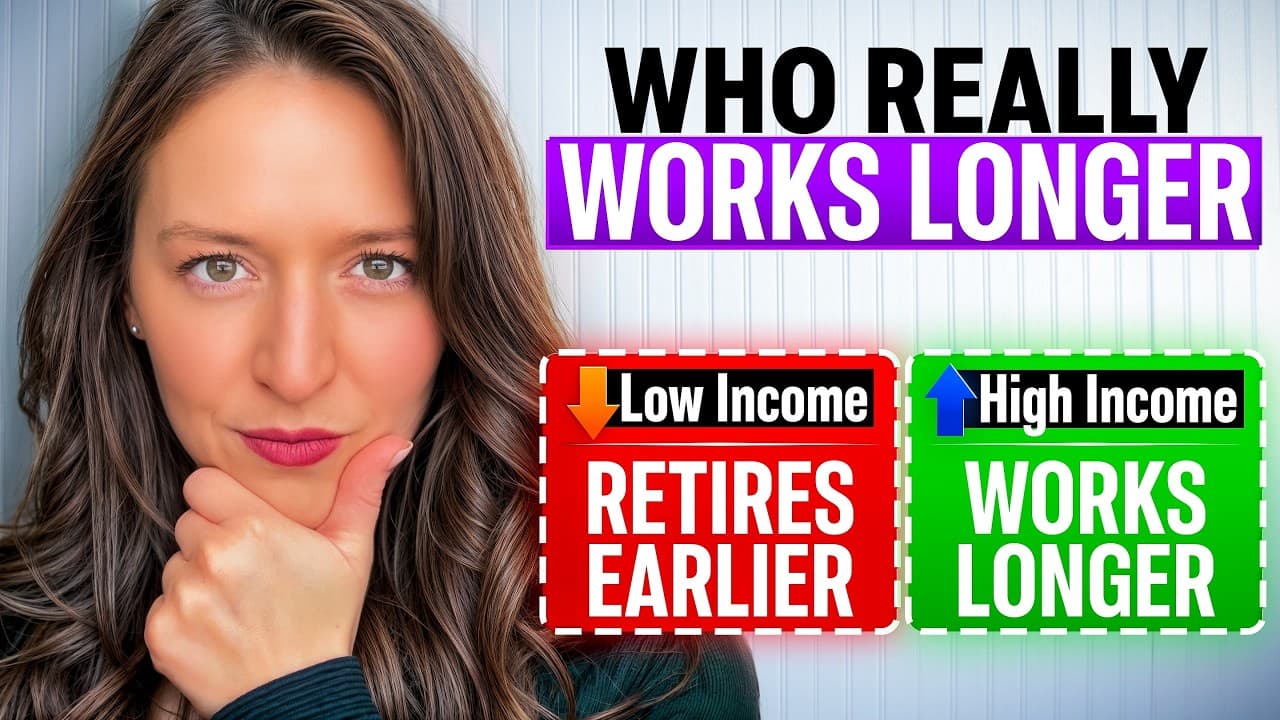
In this in-depth video on Erin Talks Money, Erin Moriarity breaks down one of the biggest myths about retirement in America — that wealthy Americans retire early while lower-income workers keep working forever. Using decades of real data from major retirement studies, labor statistics, and Social Security research, this video reveals the surprising truth about who actually retires early, who keeps working into their late 60s and 70s, and why retirement timing is often not a choice at all. Most Americans plan to work longer to boost savings, delay Social Security benefits, and gradually transition into retirement. But real-world data shows that a majority of workers end up retiring earlier than expected, often due to health problems, physically demanding jobs, layoffs in their late 50s and early 60s, and caregiving responsibilities. Early retirement is frequently involuntary, not a financial milestone. The video uncovers the surprising group that actually works the longest in America — higher-income earners. Labor force participation data shows that higher earners are nearly twice as likely to still be working in their late 60s and early 70s compared to lower-income workers. It explains how career type, health outcomes, job flexibility, and control over work schedules play a major role in determining who gets to keep working longer and who is forced out earlier. This retirement planning video also explores why retirement income statistics can be misleading, showing how households that continue earning paychecks after age 65 often skew median income numbers higher. Fully retired households typically live on much lower incomes, often relying primarily on Social Security benefits. The video further breaks down Social Security claiming patterns, revealing how lower earners are far more likely to claim benefits early at age 62 out of necessity, while higher earners are more likely to delay claiming to full retirement age or age 70 to maximize lifetime benefits. Claiming behavior closely mirrors the same retirement timing divide seen across income levels. To make the data real, the video walks through two realistic household examples — a lower-income couple forced to retire early and claim reduced Social Security benefits, and a higher-income couple able to work longer, delay benefits, and continue earning part-time income — showing how retirement income outcomes can differ by more than three times. Finally, viewers are given practical, actionable retirement planning strategies to improve their financial future, including building flexible plans that account for involuntary early retirement, focusing on career flexibility, protecting Social Security timing, and prioritizing long-term health to increase both financial security and quality of life in retirement. 00:00 Intro: Who Gets to Choose When They Retire — And Who Doesn’t 00:44 Early Retirement Is Often Not a Choice (What the Data Shows) 02:45 The Surprising Group That Works the Longest Into Retirement Age 04:46 Why This Happens: Structural Factors, Not Just Savings 07:21 Why Retirement Income Statistics Can Feel Misleading 09:47 Social Security Claiming Patterns Reveal a Deep Retirement Divide 11:14 Why Social Security Claiming Isn’t Just About Optimization 11:58 Case Study: Two Households, Two Very Different Retirements 15:53 How to Use This Insight to Improve Your Own Retirement Plan 16:09 Why You Shouldn’t Assume You’ll Work Into Your Late 60s or 70s 17:00 Build Career Flexibility — Not Just a Bigger Nest Egg 17:53 Why Social Security Timing Is One of the Most Critical Decisions 18:44 Health May Be Your Most Important Retirement Asset 20:25 Bloopers Sources: Health and Retirement Study: https://hrs.isr.umich.edu/about Center for Retirement Research: https://crr.bc.edu/ Bureau of Labor Statistics: https://www.bls.gov/opub/btn/volume-14/golden-years-older-americans-at-work-and-play.htm Centers for Disease Control and Prevention: https://www.cdc.gov/chronic-disease/about/index.html Social Security Facts and Figures: https://www.ssa.gov/policy/docs/chartbooks/fast_facts/2025/fast_facts25.html Some of my favorite books: https://amzn.to/3KF3tlr Camera & equipment I use: https://amzn.to/3Z20lof Disclaimer: Please note that this video is made for entertainment purposes only and not to be taken as financial advice. Always make sure to do your own research. Join the family & subscribe to my channel here: https://www.youtube.com/c/ErinTalksMoney Thanks for watching, I appreciate you!
About YouTube Real-Time View Count
With SocialCounts.org’s view counter, track your YouTube video’s live view count and YouTube likes count in real time with fast, reliable updates.
Watch every YouTube video live view count rise with our real-time YouTube views tracker—built for accuracy and minimal delay.
Follow YouTube real time views as they happen, using our dedicated view counter for YouTube videos.
Get up-to-date live view count on YouTube and see real-time growth with SocialCounts.org’s smart tracking tools.
Embed Widget
Parameters:
fullscreen=true- Fullscreen countergraph=true- Live graph chartcounter=0/1/2- Select counter (0=likes, 1=views, 2=comments)
URL
Click to copy the embed URL to your clipboard